
New Delhi: Senior Congress leader Jairam Ramesh has urged the Union Environment Ministry to immediately halt and conduct a comprehensive review of the ambitious Great Nicobar Island Development Project, cautioning that the initiative risks destroying one of India’s most ecologically sensitive and irreplaceable landscapes.
In a detailed letter to Union Environment Minister Bhupender Yadav, the former environment minister argued that recent government clarifications have failed to address deep-seated concerns raised by scientists, conservationists, anthropologists, local communities and tribal groups. The intervention, spotlighted by a news agency, comes days after Leader of Opposition Rahul Gandhi visited the remote Andaman and Nicobar islands on April 28, intensifying political focus on the project.
Also Read: Great Nicobar mega-project back in social media spotlight
Scale and Strategic Vision of the Project
The Great Nicobar Island Development Project, steered by NITI Aayog and the Andaman and Nicobar Islands Integrated Development Corporation, is envisioned as a transformative ₹81,000 crore venture. It aims to reshape the southern part of Great Nicobar — India’s southernmost outpost, strategically located near the vital Malacca Strait — into a major hub featuring an international container transshipment terminal at Galathea Bay, a greenfield dual-use airport, a combined gas and solar power plant, and a new township.Its supporters say the project will improve India’s maritime logistics, cut reliance on foreign ports, boost trade and tourism and strengthen national security in a geopolitically fraught region.
Government’s Defence of Clearances and Mitigation
Official estimates suggest the project will involve diverting roughly 130 square kilometres of forest land across about one-fifth of the island. The government has maintained that all statutory clearances were obtained following due process and that the ecological footprint remains limited — equivalent to just 1.82 percent of the total forest area in the Andaman and Nicobar Islands. Authorities have pointed to compensatory afforestation plans on the mainland, phased implementation spread over three decades, and the retention of green buffers as evidence of responsible planning.
Also Read: Veer Savarkar Int’l Airport in Port Blair gets night landing gear
Critics Highlight Biodiversity Risks
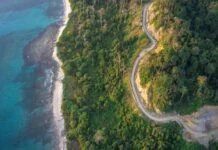
Critics of the project, including Ramesh, view the project in a clearly different way. They say Great Nicobar lies within a UNESCO biosphere reserve and ranks among the world’s biodiversity hotspots, sheltering dense tropical rainforests, mangroves, coral reefs, and vital nesting grounds for endangered leatherback turtles. The island continues to yield discoveries of new species, underscoring its ecological richness. Ramesh has highlighted inconsistencies in reported figures for tree felling, questioned the wisdom of large-scale development in a seismically active zone still recovering from the 2004 tsunami, and flagged the location of the proposed port within a strictly regulated Coastal Regulation Zone.
Concerns Over Indigenous Communities
Concerns for Indigenous Communities Environmentalists are concerned about the irreversible loss of habitat and fragmentation of primary forests, damage to marine ecosystems, and threats to the traditional lands and ways of life of the indigenous Shompen – a Particularly Vulnerable Tribal Group – and Nicobarese communities. Doubts persist about the effectiveness of proposed mitigation measures, such as relocating turtles or corals, while questions linger regarding the adequacy of consultations and the transparency of the clearance process. Although the National Green Tribunal has upheld the project, sceptics continue to challenge the depth of scrutiny applied.
Rahul Gandhi’s Strong Opposition and Recent Visit
Rahul Gandhi has strongly opposed the project (variously estimated at ₹72,000–92,000 crore), calling it an “environmental scam” and “one of the biggest scams and gravest crimes against this country’s natural and tribal heritage in our lifetime.”
During his visit to Great Nicobar Island on April 28, 2026, Gandhi travelled through the dense forests, met with Nicobarese community leaders in Campbell Bay (Rajiv Nagar), and heard their fears about displacement and loss of traditional lands. He described the forests as among the most extraordinary he had ever seen and criticised the project sharply: “The government calls what it is doing here a ‘Project.’ What I have seen is not a project. It is millions of trees marked for the axe. It is 160 square kilometres of rainforest condemned to die. It is communities that have been ignored while their homes have been snatched away. This is not development. This is destruction dressed in development’s language.”
Gandhi assured the local communities that he would raise their issues in Parliament and has since amplified his criticism, alleging inadequate consultation and threats to both ecology and indigenous rights. His visit, part of a three-day trip to the Andaman and Nicobar Islands (April 26–28, 2026), has intensified political scrutiny on the project.
Political Call for Parliamentary Debate
Ramesh has described the government’s early May press note — released shortly after Gandhi’s visit — as insufficient damage control that sidesteps fundamental ecological, financial, strategic, and procedural issues. The Congress has demanded a full debate in Parliament on the matter.
Balancing Development and Conservation
The controversy reflects a deeper national tension between developmental imperatives and environmental stewardship. Supporters emphasise that modern safeguards and the project’s phased approach can reconcile progress with protection, delivering economic opportunities to a remote region. Opponents counter that the long-term costs to a fragile, globally significant ecosystem may prove too high in an era of climate vulnerability.
As Jairam Ramesh’s letter reaches the minister’s desk, the future of Great Nicobar hangs in the balance. Whether authorities opt for a pause and fresh evaluation or accelerate implementation will carry implications far beyond the island — testing India’s ability to balance strategic ambition with its commitments to biodiversity and indigenous rights in one of the planet’s most delicate corners. For now, the ancient forests and the growing chorus of voices raised on their behalf await a decisive response.
Rahul Gandhi has strongly opposed the ₹72,000 crore Great Nicobar Holistic Development Project, calling it an “environmental scam” and a “crime against India’s natural & tribal heritage.” The ambitious project includes, Transshipment port, International airport and Power plant & new townships
Why it matters?
Strategic location near Malacca Strait — could reduce India’s dependence on foreign ports amid Indo-Pacific tensions. Supporters (including military veterans) call it vital for national security & economic growth. But, many people fear that the project would destroy 160 sq km of rainforest and impact on endangered leatherback turtles
Senior Congress leader Jairam Ramesh demands immediate halt and review of the ₹81,000 crore Great Nicobar Island Development Project over ecological and tribal concerns.