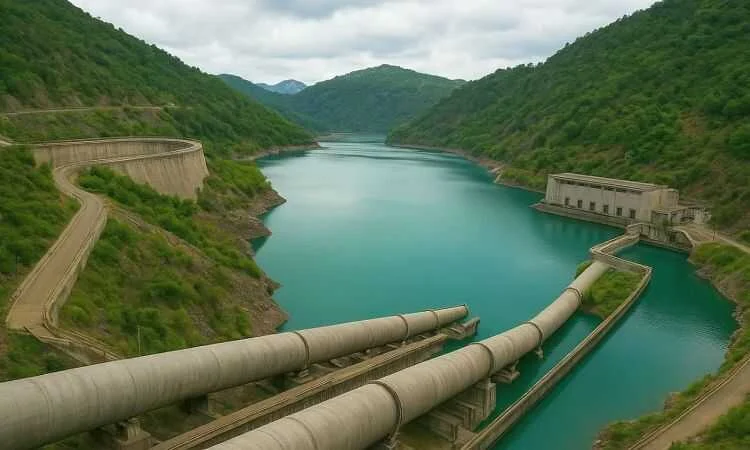
New Delhi: SJVN Limited, a Navratna public sector undertaking (PSU), issued a path-breaking tender inviting experienced developers — both domestic and international — to propose, finance, construct, own and operate pumped storage hydropower projects (PSPs) with a total capacity of up to 2,000 MW anywhere in India under the Build-Own-Operate (BOO) model. This is one of the largest single-stage PSP tenders ever floated in the country and represents a complete shift from the conventional EPC approach.
Unique developer-led approach
Unlike earlier tenders where the project authority identified sites and awarded construction contracts, SJVN has placed the entire onus on the developer. From site identification and topographic surveys to preparation of pre-feasibility reports, detailed project reports (DPRs), obtaining all statutory and environmental clearances, arranging grid connectivity to the nearest ISTS pooling station, financing, engineering, construction, and long-term operation — everything rests with the selected bidder. SJVN’s primary role will be that of a reliable long-term off-taker for one complete daily charge-discharge cycle.
Also Read: Tata Power Renewable, SJVN ink pact to build 460mw FDRE plant
Key technical and commercial parameters
Each project must have a minimum capacity of 50 MW. The plants are required to deliver at least eight hours of total discharge in a day, with the ability to supply rated power continuously for a minimum of five hours (which may be split into two sessions). Round-trip energy recovery is capped at 75 %, and the design life is fixed at 40 years, and developers must freeze and submit their chosen site configuration along with the bid itself — no subsequent changes will be allowed. The last date for bid submission is 27 January 2026.
Alignment with SJVN’s ambitious growth strategy
The tender dovetails perfectly with SJVN’s aggressive diversification beyond traditional run-of-river hydropower. The company has set itself a target of 25,000 MW installed capacity by 2030 and 50,000 MW by 2040, with a significant share coming from solar, wind, and especially pumped storage. Through its wholly-owned subsidiary SJVN Green Energy Limited (SGEL), it already has more than 17 GW of PSP capacity in various stages of development across Mizoram, Bihar, Maharashtra and other states. Notable ongoing initiatives include the 2,400 MW Darzo Lui project in Mizoram (LoI issued July 2024), the 1,000 MW Hathidah Durgawati PSP in Bihar, and a massive 8,100 MW cluster across five sites in Maharashtra signed in September 2024.
Also Read: Adani Power among 4 bidders for Pirpainti thermal power plant
Why this tender matters for India’s grid
India’s renewable capacity crossed 200 GW in 2025, but the intermittent nature of solar and wind is creating severe grid imbalances. Peak demand is projected to reach 300 GW by 2030, and large-scale, long-duration storage has become non-negotiable. While the country has an assessed pumped storage potential of over 106 GW, only 4.75 GW is installed today. Recent policy enablers — recognition of PSPs as renewable energy, waiver of ISTS charges, single-window clearance systems, and viability-gap funding — are finally unlocking this huge potential.
Pumped storage vs battery storage
For durations beyond four hours, pumped storage remains far more economical and durable than lithium-ion batteries. Modern PSPs offer asset lives of 70–100 years (versus 12–15 years for batteries), lower levelized cost of storage, provision of grid inertia and black-start capability, and virtually no degradation or end-of-life recycling issues. The recent commissioning of variable-speed units at the 1,000 MW Tehri PSP in December 2025 has shown that PSPs can switch from pumping to generation mode in under 90 seconds — making them the perfect partner for variable renewables.
Also Read: Farmers’ unrest over land acquisition hampers Buxar power plant
Opportunity for developers
The BOO structure allows developers to own a high-life infrastructure asset with stable, long-term cash flows backed by a power purchase agreement with SJVN, which enjoys a strong credit rating. Every 1 GW of new PSP capacity can confidently support an additional 4–5 GW of solar and wind, drastically reduce renewable curtailment (currently 5–10 % in many states), and eliminate the need for expensive gas-based peaking plants.
SJVN’s 2 GW BOO tender is far more than a routine procurement exercise — it is a powerful market signal that India is ready to build the energy storage backbone required to achieve 500 GW of non-fossil capacity by 2030 and net-zero emissions by 2070. The response to this tender in early 2026 will serve as a clear indicator of private-sector confidence in India’s pumped storage story and will likely trigger a wave of similar large-scale initiatives across the country.