
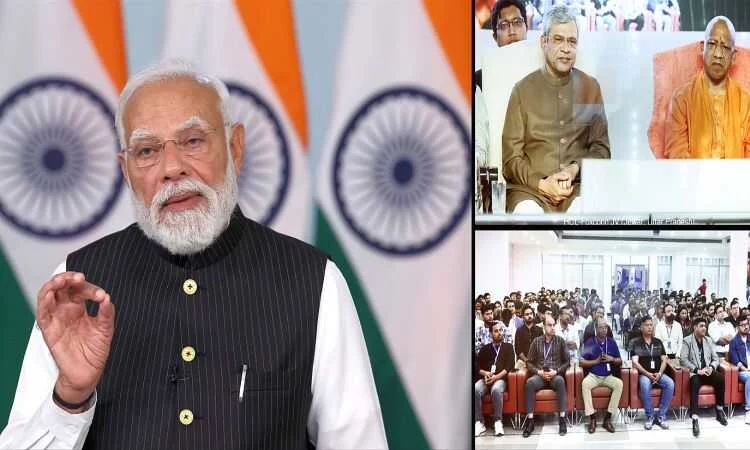
Greater Noida: Prime Minister Narendra Modi on Saturday virtually laid the foundation stone for Uttar Pradesh’s first semiconductor facility and North India’s maiden Outsourced Semiconductor Assembly and Test (OSAT) unit, marking a landmark step in India’s push towards self-reliance in critical electronics manufacturing.
The ₹3,700-crore (approximately ₹4,000 crore) project by India Chip Private Limited — a 60:40 joint venture between the HCL Group and Taiwan’s Foxconn — will come up on 48 acres in Sector 28 of the Yamuna Expressway Industrial Development Authority (YEIDA) region near Jewar. The timing of the ceremony, held while the high-profile India AI Impact Summit 2026 was concluding in New Delhi (February 16-20), underscored the government’s integrated vision of advancing artificial intelligence alongside the semiconductor backbone that powers it.
Also Read: IIT Madras, ISRO develop new semiconductor for space missions
Chief Minister Yogi Adityanath and Union Minister for Electronics & Information Technology, Railways and Information & Broadcasting Ashwini Vaishnaw were present at the site. The facility, expected to begin commercial production by 2028, will manufacture display driver integrated circuits (DDICs) used in smartphones, laptops, televisions, automotive displays and other consumer electronics. It is designed to process 20,000 wafers per month and produce up to 36 million chips monthly at peak capacity.
Addressing the gathering, Prime Minister Modi described the project as foundational to building a “Developed India”. “The foundation of a developed India will be laid on the basis of self-reliance, for which having chips made in India is very important,” he said. Recalling the global semiconductor shortages during the COVID-19 pandemic that crippled supply chains worldwide, the Prime Minister added that India had turned that crisis into an opportunity to strengthen its technological capabilities.
Also Read: India’s chipmaking plan suffers; Foxconn cancels deal with Vedanta
Union Minister Ashwini Vaishnaw hailed the development as a game-changer for domestic manufacturing. “The brain of the digital screens that you see will now be made in Jewar,” he remarked, noting that the plant would meet a significant portion of India’s display-driver requirements while also catering to global demand through Foxconn’s network. He highlighted that India’s electronics production has grown manifold in the last 11 years and that the country now ranks among the top exporters of electronics.
Chief Minister Yogi Adityanath described the project as a symbol of transformation for the Jewar region. “Jewar is emerging as a jewel not only for Uttar Pradesh but for the entire country,” he said, crediting the development model that has converted a once lawless area into a high-tech industrial hub aligned with Prime Minister Modi’s vision.
Also Read: ‘High-tech semiconductor courses to be launched in 600 colleges’
The project, approved under the Centre’s India Semiconductor Mission in May 2025, is among the first wave of semiconductor units to move from approval to ground-breaking. It is expected to generate over 3,500 direct and indirect jobs and catalyse a broader electronics and semiconductor ecosystem in the YEIDA region, especially with the upcoming Noida International Airport providing logistics advantages.
Industry observers see the HCL-Foxconn facility as a major milestone in India’s journey to reduce dependence on imported chips and position itself as a trusted global supply-chain partner. With the India AI Impact Summit still fresh in memory — where global tech leaders discussed responsible AI and inclusive innovation — the foundation-laying ceremony sent a clear message: India is not only building the intelligence layer of the digital future but also the silicon foundation that will power it.
Also Read: India-Lithuania agree to work in deep tech, semiconductor area
The development is part of a larger national push that has already seen ten semiconductor projects approved across six states with cumulative investments exceeding ₹1.6 lakh crore. Officials and industry leaders expect such units to significantly strengthen India’s electronics manufacturing ecosystem, which has grown rapidly in recent years and is projected to play a key role in the country’s economic growth story.